
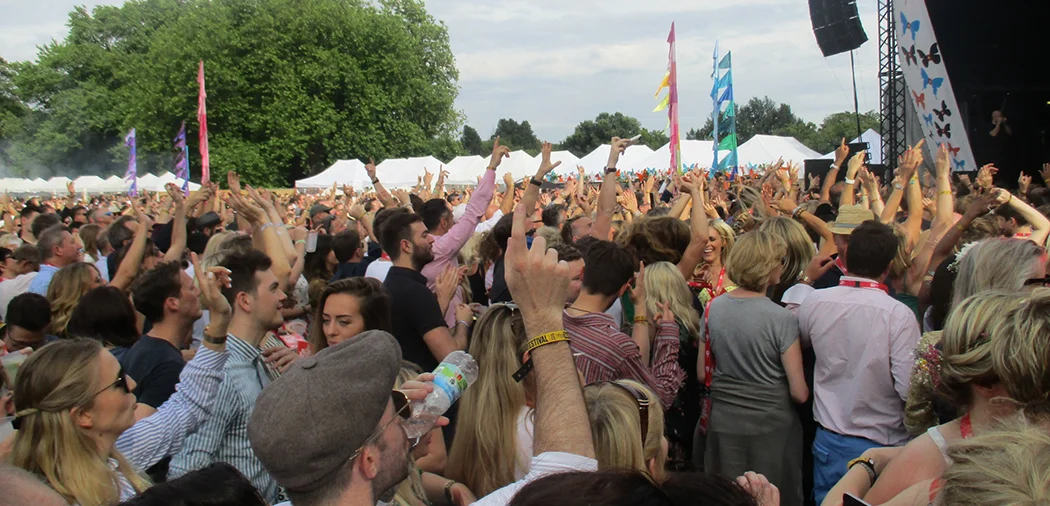
A successful festival site is rarely built around a single type of temporary structure. From the main entertainment areas to food traders, bars, ticket points and backstage facilities, different parts of an event have very different requirements.
This is why festival organisers often use a combination of marquees, gazebos, pagodas and other temporary structures rather than simply choosing one design and using it throughout the site.
A large marquee may provide an excellent covered space for hundreds of visitors, but it would be unnecessarily large for a ticket checkpoint. Likewise, a pop-up gazebo can be ideal for a trader or information point but wouldn’t provide the capacity required for a major hospitality area.
The key is understanding what each structure does well and then combining them to create a festival site that works as a whole.
Why Use Different Structures at the Same Festival?
It can be tempting to think of temporary structures primarily in terms of appearance. In reality, their purpose is much more important.
Every area of a festival has its own requirements.
A food trader may need a relatively small covered workspace with easy access to the public. A bar needs space for staff, equipment and potentially a queue. A VIP hospitality area might need substantially more covered floor space, while first aid and event control need quieter, more secure locations away from the busiest public areas.
There are also practical considerations such as:
- the number of people using the structure
- how long they are likely to remain inside
- equipment and furniture requirements
- pedestrian movement
- vehicle and supplier access
- ground conditions
- exposure to wind and rain
- the overall layout of the festival
- how quickly individual structures need to be installed or removed
This means there is rarely a single structure that is perfect for everything.
Instead, organisers can treat temporary structures as different components of the festival infrastructure, selecting each one according to the job it needs to perform.
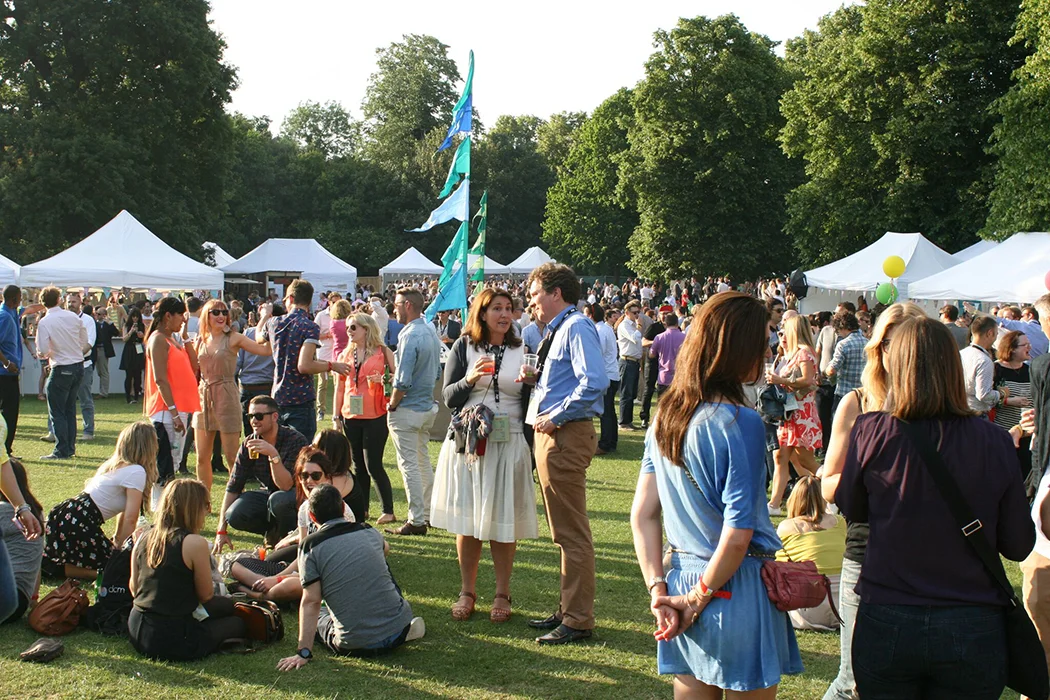
Gazebos: Small Structures With a Huge Number of Uses
Gazebos are among the most versatile structures on a festival site.
Their relatively small footprint means they can be positioned in locations where installing a larger marquee would be unnecessary or impractical. They can also be used individually or grouped together when more covered space is required.
One of their most obvious uses is for traders.
Festival markets often contain dozens of independent businesses selling food, drinks, clothing, crafts and other products. A gazebo gives each trader a defined covered area without requiring the organiser to construct one enormous retail marquee.
But traders are only one example.
Gazebos can also work well for:
- ticket collection
- accreditation
- security checkpoints
- information points
- merchandise stands
- small food and drink outlets
- first aid points
- staff check-in
- production teams
- equipment protection
- artist or crew areas
They can also be positioned at strategic points around a festival rather than concentrating every service in one location.
For example, several information gazebos could be distributed across a large festival site so visitors don’t have to walk back to the main entrance every time they need assistance.
Their flexibility is one of the reasons gazebos often appear throughout a festival even when much larger marquees are also being used.
Larger Marquees for High-Capacity Areas
There comes a point where a gazebo simply isn’t the appropriate structure.
If an area needs to accommodate significant numbers of visitors, tables, seating, production equipment or catering facilities, a larger marquee can provide a much more practical solution.
Depending on the festival, larger marquees might be used for:
- covered entertainment areas
- dining
- hospitality
- VIP areas
- bars
- workshops
- exhibitions
- indoor markets
- backstage facilities
- production areas
The advantage isn’t simply additional square footage.
A larger uninterrupted covered area allows organisers to create a completely different type of environment. Lighting, furniture, flooring, staging, bars and decorations can all be incorporated into the space.
This makes larger marquees particularly useful when visitors are expected to spend longer periods inside rather than simply approaching a counter and moving on.
The distinction is important.
A gazebo works extremely well as a service point. A larger marquee can become a destination within the festival itself.
Pagoda Marquees for Areas That Need to Stand Out
Pagoda marquees occupy an interesting position between small gazebos and much larger event structures.
Their distinctive peaked roofs make them highly visible, which can be particularly useful on busy festival sites.
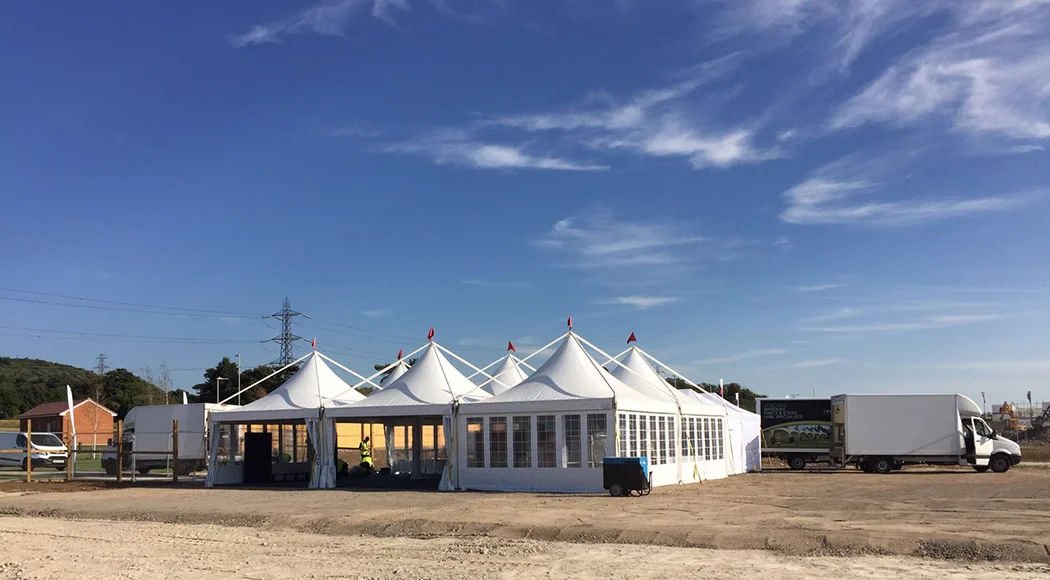
For that reason, organisers may use pagodas in locations that visitors need to identify quickly.
Examples could include:
- festival entrances
- ticketing areas
- VIP reception points
- information desks
- premium bars
- sponsor activations
- small hospitality areas
- merchandise points
Several pagodas can also be positioned next to each other to create a larger coordinated area.
This provides organisers with considerable flexibility. Instead of creating one large enclosed structure, individual units can be used to divide different functions while maintaining a consistent appearance.
The visual aspect can be useful as well.
On a large site containing dozens of tents and gazebos, a row of distinctive peaked structures can become a useful landmark. Visitors may naturally begin using them as reference points when navigating the event.
Stretch Tents for More Informal Festival Spaces
Not every covered festival area needs to feel like a conventional marquee.
Stretch tents are often used when organisers want a more open and informal environment. Their flexible shapes and relatively open sides can make them particularly suitable for social spaces where shelter is required without completely separating visitors from the wider festival.
Possible uses include:
- bars
- seating areas
- food courts
- chill-out spaces
- hospitality
- communal areas
- smaller performance spaces
They can be particularly effective when the surrounding environment forms part of the experience.
Instead of creating a completely enclosed room, the structure provides shelter while retaining visual connections with the rest of the site.
This can make stretch tents useful for areas where visitors are likely to move in and out frequently.
Matching the Structure to the Activity
Rather than asking, “Which marquee should we use for the festival?”, it can be more useful to ask:
What needs to happen in this particular part of the festival?
Consider a hypothetical festival with 3,000 visitors.
The entrance might use several pagoda marquees for ticket checks and accreditation because they are easy to identify.
Inside the site, individual food traders could operate from gazebos.
A group of gazebos could provide merchandise and information points.
A larger marquee could contain a covered bar and seating area.
Another substantial marquee might be used for hospitality.
A stretch tent could provide a relaxed communal area near the food court.
Additional gazebos could then be positioned backstage for staff, security and production requirements.
None of these structures needs to compete with the others. Each is solving a different problem.
For organisers comparing the options available, this overview of different festival marquee types provides more information about the structures commonly used at festivals and the roles they can perform.
Once those roles have been identified, the next challenge is deciding where each structure should actually go.
Think in Zones Rather Than Individual Tents
One useful way of planning a festival is to divide the site into functional zones.
For example:
Arrival zone
This could include ticketing, security, accreditation and information. Smaller structures such as gazebos and pagodas are often useful because several individual service points may be required.
Food and drink zone
Individual catering businesses may use gazebos or small marquees, while a larger covered seating or bar area could require a substantially bigger structure.
Entertainment zone
Depending on the type of festival, this might contain performance spaces, audience shelters or workshop areas.
Hospitality zone
Larger marquees may be appropriate where seating, furniture, catering and a more controlled environment are required.
Operational zone
This can include event control, staff facilities, storage, first aid, security and production teams. These areas may use a mixture of gazebos and larger temporary structures depending on their purpose.
Thinking in zones helps prevent temporary structures from being placed around the site simply because there happens to be available space.
Each structure becomes part of a wider plan.
Don’t Forget the Space Around the Structure
A common planning mistake is to consider only the footprint of the marquee or gazebo itself.
The surrounding space can be equally important.
A food gazebo, for example, may occupy a relatively small area, but customers could form a queue several metres long.
Similarly, a popular bar inside a marquee can generate considerable pedestrian traffic around its entrances.
Organisers therefore need to think about how people will approach, use and leave each structure.
Questions worth considering include:
- Where will queues form?
- Will the queue obstruct a main pedestrian route?
- Is there enough space around entrances and exits?
- Do suppliers need vehicle access?
- How will stock reach traders?
- Where will waste be collected?
- Could neighbouring structures create a bottleneck?
A structure that appears perfectly positioned on a site plan can cause problems once several hundred people begin moving around it.
Creating Clear Routes Through the Festival
The arrangement of temporary structures can also influence how visitors naturally move around a festival.
Large marquees, rows of gazebos and catering areas can effectively create streets and boundaries within an otherwise open field.
Used carefully, this can help guide people around the site.
For example, rows of trader gazebos can create a natural marketplace route. A prominent pagoda can highlight an information point. A large hospitality marquee can form the edge of a quieter premium area.
But poor positioning can have the opposite effect.
Structures placed too close together can create narrow passages. Queues can spill into busy routes, and large marquees can block sightlines that would otherwise help visitors understand where they are.
The layout therefore needs to consider the spaces between structures just as carefully as the structures themselves.
Consider Back-of-House Requirements
Visitors only see one side of a festival.
Behind the scenes there may be hundreds of staff, contractors, performers and suppliers who also need temporary facilities.
Gazebos can be particularly useful in these operational areas because they provide small, flexible covered spaces that can be distributed where required.
For example, they might be used for staff check-in, security teams, production equipment or temporary storage.
Larger backstage requirements may need marquees containing changing areas, catering, production offices or artist facilities.
These structures don’t necessarily need the same visual treatment as public-facing areas, but their positioning is extremely important.
Operational teams need to reach them without constantly crossing busy visitor areas.
Preparing for British Weather
Outdoor events in the UK inevitably need to consider changing weather conditions.
Even festivals held in the middle of summer can experience rain, wind or sudden temperature changes.
Temporary structures provide more than somewhere to stand when it rains. They can help organisers create areas of resilience throughout the site.
A covered food area allows catering to continue during showers. Gazebos protect traders and their equipment. Larger marquees provide spaces where visitors can remain at the event rather than immediately heading for the exit when conditions deteriorate.
However, weather planning isn’t simply about adding more tents.
Structures need to be suitable for their intended use and installed appropriately for the site and expected conditions. Ground conditions, anchoring requirements, drainage and exposure should all form part of the planning process.
Creating a Consistent Look Across Different Structures
Using several types of temporary structure doesn’t mean the festival needs to look disjointed.
Branding can help connect them visually.
Gazebos, pagodas and larger marquees can incorporate consistent signage, banners, colours and wayfinding.
Different structure types can even help visitors understand the site.
For example, one style could be associated with information and visitor services, while another identifies food or hospitality areas.
The physical differences between structures then become part of the festival’s visual navigation system rather than something that needs to be hidden.
Flexibility Can Be More Valuable Than Uniformity
There is an understandable appeal in making every temporary structure at an event look identical.
But festivals are complex environments.
A structure suitable for twenty traders is unlikely to be the best solution for a 300-person hospitality area. Likewise, constructing a large marquee for every small operational function would waste both space and resources.
A mixed approach allows organisers to scale the infrastructure according to actual requirements.
Small structures can handle small jobs.
Large structures can handle high-capacity areas.
Distinctive structures can highlight important locations.
Open structures can create relaxed communal spaces.
The result can be both more practical and more visually interesting than simply repeating the same tent throughout the site.
Bringing the Festival Site Together
Temporary structures are easy to think about individually: a gazebo for a trader, a marquee for hospitality, a pagoda for an entrance.
The more important question is how all of those individual elements work together.
A well-planned festival site uses temporary structures to support visitor movement, operations, catering, entertainment, staff and shelter without allowing any one element to interfere with another.
Gazebos can provide the smaller building blocks of the site, appearing wherever compact and flexible covered space is needed. Pagodas can make important areas easier to identify. Larger marquees can accommodate the parts of the festival that require substantial enclosed space, while stretch tents can create open and sociable covered environments.
There isn’t necessarily one “best” festival marquee.
The best solution is often a carefully planned combination of structures, with each one chosen for a specific purpose and positioned as part of the wider event.
When that happens, marquees and gazebos stop being individual pieces of equipment and become part of the infrastructure that makes the entire festival work.